

Pokémon Go
(stylized as Pokémon GO) is a free-to-play location-based augmented reality mobile game developed by Niantic and published by The Pokémon Company. It was released in July 2016 for iOS and Android devices.
The game allows players to capture, battle, and train virtual creatures, called Pokémon, who appear throughout the real world. It makes use of GPS and the camera of compatible devices. The game is free-to-play, although it supports in-app purchases of additional gameplay items. An optional companion Bluetooth wearable device is planned for future release, the Pokémon Go Plus, and will alert users when Pokémon are nearby.
The game quickly became one of the most used smart device apps after launching, surpassing the previous record held by Candy Crush Saga in the United States, and was a boon to the stock value of Nintendo, which owns a part of The Pokémon Company. It was praised by some medical professionals for potentially improving the mental and physical health of players, but attracted some controversy due to reports of causing accidents and being a public nuisance at some locations
Gameplay
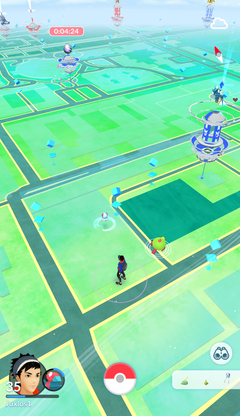

After logging into the app for the first time, the player creates their avatar. The player can choose the avatar's style, hair, skin, and eye color, and can choose from a limited number of outfits.[1] After the avatar is created, it is displayed at the player's current location along with a map of the player's immediate surroundings. Features on the map include a number of PokéStops and Pokémon gyms. These are typically located at public art installations, historical markers, historic buildings, cenotaphs and other memorials, public parks and fountains, places of worship, and other points of cultural significance;[2][3] these locations are repurposed Ingress portals, Niantic's previous augmented reality game.[4]
As players travel the real world, the avatar moves along the game's map. Different Pokémon species reside in different areas of the world; for example, water-type Pokémon are generally found near water.[5] When a player encounters a Pokémon, they may view it either in augmented reality (AR) mode or with a live rendered, generic background.[6] AR mode uses the camera and gyroscope on the player's mobile device to display an image of a Pokémon as though it were in the real world.[7] Players can take screen shots of the Pokémon they encounter either with or without the AR mode activated.[5]
Unlike other installments in the Pokémon series, players in Pokémon Go do not battle wild Pokémon to capture them. During an encounter with a wild Pokémon, the player may throw a Poké Ball at it. If the Pokémon is successfully caught, it will come under the ownership of the player. Factors in the success rate of capture include the right force, the right time and the type of Poké Ball used. After capturing a wild Pokémon, the player is awarded two types of in-game currencies: candies and stardust. The candies awarded by a successful catch depends on what evolutionary chain a Pokémon belongs to. A player can use stardust and candies to raise a Pokémon's "combat power" (CP). However, only candies are needed to evolve a Pokémon. Each Pokémon evolution tree has its own type of candy which can only be used to evolve or level up. The player can also transfer the Pokémon back to the Pokémon professor to earn one more candy and create room for more Pokémon.[8] The ultimate goal of the game is to complete the entries in the Pokédex, a comprehensive Pokémon encyclopedia, by capturing and evolving to obtain the original 151 Pokémon.[9]
All Pokémon are displayed with a combat power. A Pokémon's combat power is a rough measure of how powerful that Pokémon is in battle. Not all Pokémon of the same species will have the same CP. Generally, as a player levels up they will catch Pokémon with higher CP.[10]
Players earn experience points for various in-game activities. Players rise in level as they earn experience points. At level five, the player is able to battle at a Pokémon gym and join one of three teams (red for Team Valor, which uses Moltres as their mascot; blue for Team Mystic, which uses Articuno as their mascot; or yellow for Team Instinct, which uses Zapdos as their mascot) which act as larger factions within the Pokémon Go world. If a player enters a Pokémon gym that is controlled by a player that is not part of their team, they can challenge the leader to lower the gym's "prestige". Once the prestige of a gym is lowered to zero then the player will take control of the gym and is able to deposit one Pokémon to defend it. Similarly, a team can upgrade the prestige of a gym under their control by battling the gym leader.[5]
Although the game is free-to-play, it supports in-app purchases of Poké Balls and other items.[11] By July 14, players were able to submit requests for new Pokéstops and gyms to be included in the game.[12][13]
Development
The concept for the game was conceived in 2014 by Satoru Iwata of Nintendo and Tsunekazu Ishihara of The Pokémon Company as an April Fools' Day collaboration with Google, called Pokémon Challenge.[14] Ishihara had been a big fan of developer Niantic's previous augmented reality game, Ingress, and saw the game's concept as a perfect match for the Pokémon series.[15] Niantic used data from Ingress to populate the locations for Pokéstops and gyms within Pokémon Go.[16] In 2015, Ishihara dedicated his speech at the game's announcement on September 10 to Iwata, who had died two months earlier.[17] The game's soundtrack was written by longtime Pokémon series composer, Junichi Masuda, who also assisted with some of the game's design.[18] Among the game's visual designers was Dennis Hwang, who had previously worked at Google and created the logo of Gmail.[19]On March 4, 2016, Niantic announced a Japan-exclusive beta test would begin later that month, allowing players to assist in refining the game before its full release. The beta test was later expanded to other countries.[20] On April 7, it was announced that the beta would expand to Australia and New Zealand.[21] Then, on May 16, the signups for the field test were opened to the United States.[22][23] The test came to an end on June 30.[24]

Pokémon Go Plus
The Pokémon Go Plus is a Bluetooth low energy wearable device that allows the player to traverse the game map without looking at their smart device.[25] When the player is near a Pokémon or Pokéstop, the Plus vibrates.[25] The player can then press the button to capture the Pokémon. The player cannot check what they have caught until it is connected to a mobile device or a tablet.[26] It is set for release sometime in July 2016.[27] The design is a combination of a Poké Ball and the shape of the Google Maps pin.[25] The Plus, which had a pre-order cost of $34.99,[28] was being listed on eBay for over $100 after Amazon, GameStop and the official Pokémon store sold out.[29]The decision to create the device rather than create a smart watch app was to increase uptake among players for whom a smart watch is prohibitively expensive.[30]
No comments:
Write comments